In short
Yes. Five dedicated desks at ByzBay Pune cost ₹47,950 a month before GST, or ₹56,581 with 18% GST, and an employer of record can employ the people who sit at them. The EOR is the legal employer and runs payroll. Who signs the workspace agreement, and what the team does in India, shapes your permanent establishment risk and whether you can recover the GST.
Key takeaways
- An employer of record is the legal employer in India, but how much control the foreign company exercises still matters for foreign exchange, labour and tax risk.
- Five dedicated desks at ByzBay Pune cost ₹47,950 a month before GST and ₹56,581 with 18% GST.
- Paying from abroad does not by itself make a Pune seat an export: where the agreement grants a right to use the space, section 13(4) of the IGST Act puts the place of supply where the property is.
- Keep the workspace agreement and contract signing authority away from the foreign parent where you can, and take advice under your country's tax treaty with India.
- Move to an Indian subsidiary when the team starts selling locally, unrecoverable GST becomes material or you need equity plans for India staff.
How does an employer of record let a foreign company hire in India without its own entity?
An employer of record, often called a professional employer organisation or PEO in India, is an Indian company that puts your people on its own payroll. It issues the employment contracts, pays salaries, makes the statutory social security payments and handles exits. You pay the EOR the employment cost plus a service fee, and you direct the work under a services agreement. As AZB & Partners puts it, for all legal purposes the PEO is the employer of the workforce.
The appeal is speed and cost. Incorporating a subsidiary, opening a bank account and completing registrations takes time and money. A practice note by Khaitan & Co for the Association of Corporate Counsel observes that, while a foreign company is still exploring its business prospects in India, establishing a physical presence for a limited number of people may not be practical or even feasible from a cost perspective.
The model has limits that you manage through behaviour, not only paperwork. AZB warns that where the foreign company directly controls the workers, the arrangement may be treated as a sham under India's foreign exchange law, and the workers may argue that they are really your employees. The usual safeguards are:
- A principal-to-principal services agreement with the EOR.
- Monthly proof that wages and social security contributions have been paid before you release the EOR's invoice.
- A specific clause assigning intellectual property created by the team to your company.
- Supervision of outcomes rather than day-to-day control, as far as the work allows.
Who should sign the coworking agreement: the foreign parent, the EOR or a future Indian subsidiary?
There are three realistic options, and each moves risk and cost to a different place.
Whichever entity signs, ByzBay gives each person their own access card, and bookings, invoices and support run through the member app. Access hours are set by the membership and stated in the agreement, which matters if your India team overlaps with European or US working hours.
- The EOR signs and re-bills you. This keeps the foreign parent's name off an Indian workspace contract. Ask whether your EOR offers it, what mark-up it adds and how it charges GST on the re-bill.
- The foreign parent signs directly. This is commercially straightforward, but it places a workspace in India at the parent's disposal, which matters for permanent establishment, and the parent has no Indian GST registration to recover the 18% GST. The same ACC note says Indian labour laws generally do not apply to a foreign entity that has no establishment, office, subsidiary or joint venture in India; an office contract in the parent's own name could affect that position.
- An Indian subsidiary signs. Once the subsidiary exists and employs the team, the same company holds the workspace, and it can register for GST and claim input tax credit.
Can a desk in India create permanent establishment risk for the foreign parent, and how do you limit it?
Yes, it can. Permanent establishment, or PE, is a tax treaty concept. Article 5 of the India UK tax treaty, for example, describes a PE as a fixed place of business through which the business of an enterprise is wholly or partly carried on. If a PE exists, India can tax the business profits attributable to it.
In Formula One World Championship v Commissioner of Income Tax, decided on 24 April 2017, the Supreme Court of India held that a race circuit was a fixed place PE even though Formula One had access to it for only up to about six weeks at a time around each race. What counted was that the circuit was at Formula One's disposal and under its control. For a coworking desk, the lesson is that control and regular use count for more than whose name is on the building.
The ACC note adds that people working in India can create a taxable presence depending on how long they are there and what they do, and that fixed place, service and agency PE can each arise under treaty terms. AZB stresses that the analysis is fact-specific. Practical steps that reduce exposure:
This article is general information, not tax or legal advice; ask a chartered accountant or lawyer to review your facts and the treaty that applies to you.
- Do not let India staff negotiate or sign contracts on behalf of the foreign parent.
- Keep the workspace agreement with the EOR or an Indian subsidiary where you can.
- Write down what the India team does and review it every 6 months, because roles drift as teams grow.
- Get written advice under the treaty between India and your home country before you sign anything.
How is GST charged when a foreign company pays for seats in India?
Workspace fees in India are generally taxed at 18% GST. The GST Council's rate schedule lists real estate services under heading 9972 at 9% central tax plus 9% state tax, which is how a supply inside Maharashtra is invoiced.
Paying from abroad does not by itself turn the fee into a zero-rated export. Section 13 of the IGST Act applies when the supplier or the recipient is outside India, and section 13(4) sets the place of supply for services directly in relation to immovable property, including the grant of rights to use it, as the place where the property is located. CBIC Circular 232/26/2024, dated 10 September 2024, restates that section 13(4) covers services directly in relation to immovable property, but it also found that data hosting, a bundle of space, power backup, connectivity and monitoring, was not such a service. A membership that bundles a desk with fibre, power backup and housekeeping is therefore classified on its terms. Where it is a grant of the right to use space in Pimpri, Pune, the place of supply is in India and GST is charged. Ask your adviser to confirm how your particular agreement is classified.
The practical question is whether you can recover that 18%. A foreign parent with no Indian GST registration cannot. A GST-registered Indian company can generally claim input tax credit under section 16 of the CGST Act on inputs used in its business, provided it holds a valid tax invoice, the supplier has reported it and the tax has been paid. On 5 dedicated desks the GST is ₹8,631 a month, or ₹1,03,572 a year, so the choice of signing entity is a real cost decision.
What does a 5-person team cost at ByzBay Pune?
Starting prices at ByzBay Pune for a team of 5, before GST unless stated:
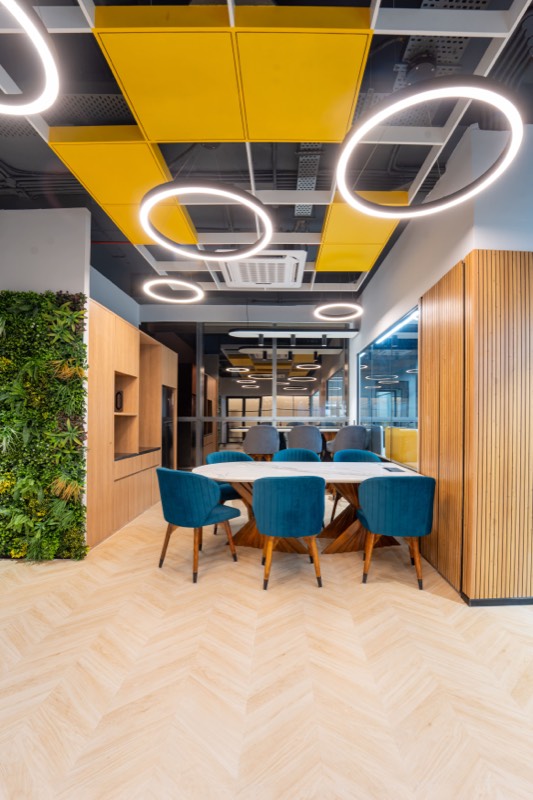
Every seat includes dual fibre, UPS backup power, meeting-room credits, housekeeping on a checklist with photo proof, the member app and an access card per person. These prices do not include the EOR's fee or salaries.
If the signing company was incorporated less than five years before it signs, ByzBay's startup offer takes 10% off membership fees, which brings 5 dedicated desks to ₹43,155 a month before GST. The same offer includes up to $6,000 in partner credits from the AWS, Google Cloud and Microsoft startup programmes; each partner decides eligibility and amount.
On availability: the current centre, with 130+ seats, is 124% booked across day and night shifts. A new space in the same premises goes live in January 2027, and registering interest early gets up to 10% off with code EOI10.
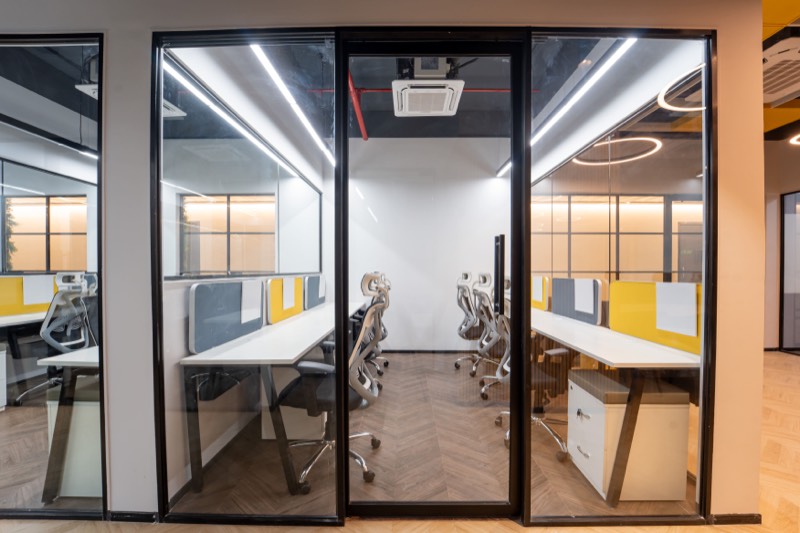
- 5 dedicated desks at ₹9,590 per seat: ₹47,950 a month, ₹56,581 with 18% GST, or ₹6,78,972 a year with GST.
- 5 seats in a software team suite at ₹10,270 per seat: ₹51,350 a month.
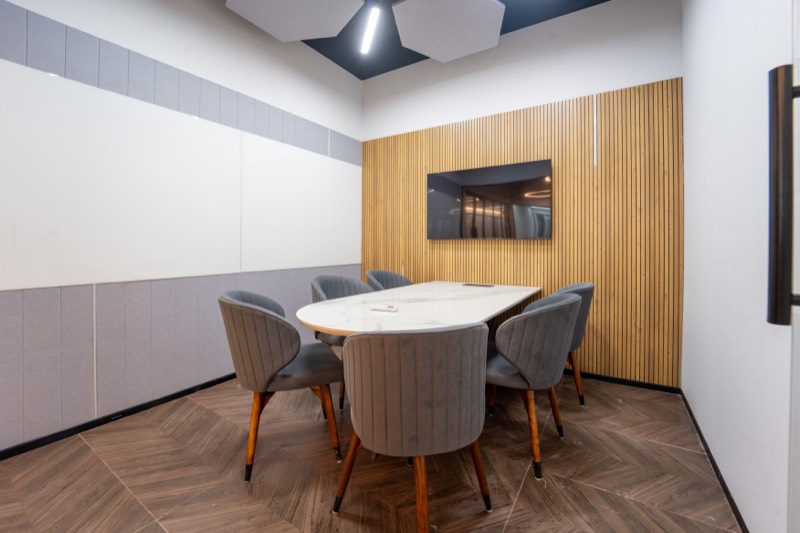
- 5 seats in a private cabin at ₹10,859 per seat: ₹54,295 a month.
- Meeting rooms and the conference room for leadership or client visits at ₹890 an hour, in addition to the meeting-room credits included with every seat.
When should you move from EOR and coworking to your own subsidiary and a managed office?
No legal headcount forces the move. The signals are commercial and tax ones:
One workable sequence is EOR employment plus coworking seats now, incorporation of a subsidiary while the team proves itself, then a managed office signed by the subsidiary. ByzBay's managed offices run on terms from 3 years with a fixed 4-month security deposit, and one fee covers design, fit-out capital, build and project management, contractor coordination, housekeeping, security, pantry, Wi-Fi, electricity and maintenance. ByzBay designs and builds any office under 10,000 sq ft in 75 days, counted from the day both sides sign off the final design and the site is handed over, and holds a mandate for up to 30,000 sq ft in the new space going live in January 2027.
- The India team is about to sell, negotiate or sign contracts locally, which raises PE risk for the parent.
- The GST you cannot recover becomes material. At 20 dedicated desks it is ₹34,524 a month.
- You want to offer equity. AZB notes that stock options, RSUs and SARs may not be available to staff engaged through a PEO.
- You expect to stay 3 years or more and want a floor plan built around your team.
Questions
Can the foreign company pay ByzBay directly for desks used by EOR employees?
Commercially it can, but the payer and signer affect your PE position and GST recovery. A foreign parent with no Indian GST registration generally pays 18% GST it cannot claim back, and the workspace sits at its disposal, so take advice before choosing.
Is a single coworking desk enough to create a permanent establishment?
Not automatically. It depends on whether the parent's business is carried on through that place, who controls it, how long it is used and the treaty that applies. The Supreme Court's 2017 Formula One ruling found a PE where the company had access for up to about six weeks at a time, because the place was at its disposal and under its control.
Can a foreign parent recover GST paid on Indian seats?
Not through the Indian GST system unless it is registered in India. An Indian subsidiary registered for GST can generally claim input tax credit under section 16 of the CGST Act, subject to holding a valid invoice and meeting the other conditions.
Does ByzBay's startup discount apply to a foreign company?
The offer gives 10% off membership fees to companies incorporated less than five years before they sign, plus up to $6,000 in partner credits, where each partner decides eligibility and amount. Confirm with ByzBay that the entity signing the agreement qualifies before you sign.
What does the EOR handle and what does ByzBay handle?
The EOR handles employment contracts, payroll, statutory payments and exits. ByzBay provides the seats, dual fibre, UPS backup power, housekeeping, meeting-room credits, access cards and invoices through the member app.
How soon can a 5-person team move in?
The current centre is 124% booked across day and night shifts, so ask ByzBay about availability for your start date. A new space in the same premises goes live in January 2027, and registering interest early with code EOI10 gets up to 10% off.
Sources
- AZB & Partners: Engaging a Professional Employer Organisation in India, Challenges and Risks (21.12.2023)
- ACC Corporate Counsel Now: Engaging Workforce in India, Key Considerations for Foreign Entities (Khaitan & Co, 25.01.2023)
- Kluwer International Tax Blog: Racing circuit constitutes fixed place PE, Indian Supreme Court rules
- CBIC Circular No. 232/26/2024-GST (10.09.2024)
- Teachoo: Section 13 IGST Act, place of supply where supplier or recipient is outside India
- GST Council: GST rates for services, heading 9972
- Taxmann: Input Tax Credit under GST, section 16 conditions